How to Find the Best Cruise Deals and Understand Confusing Cruise Promotions
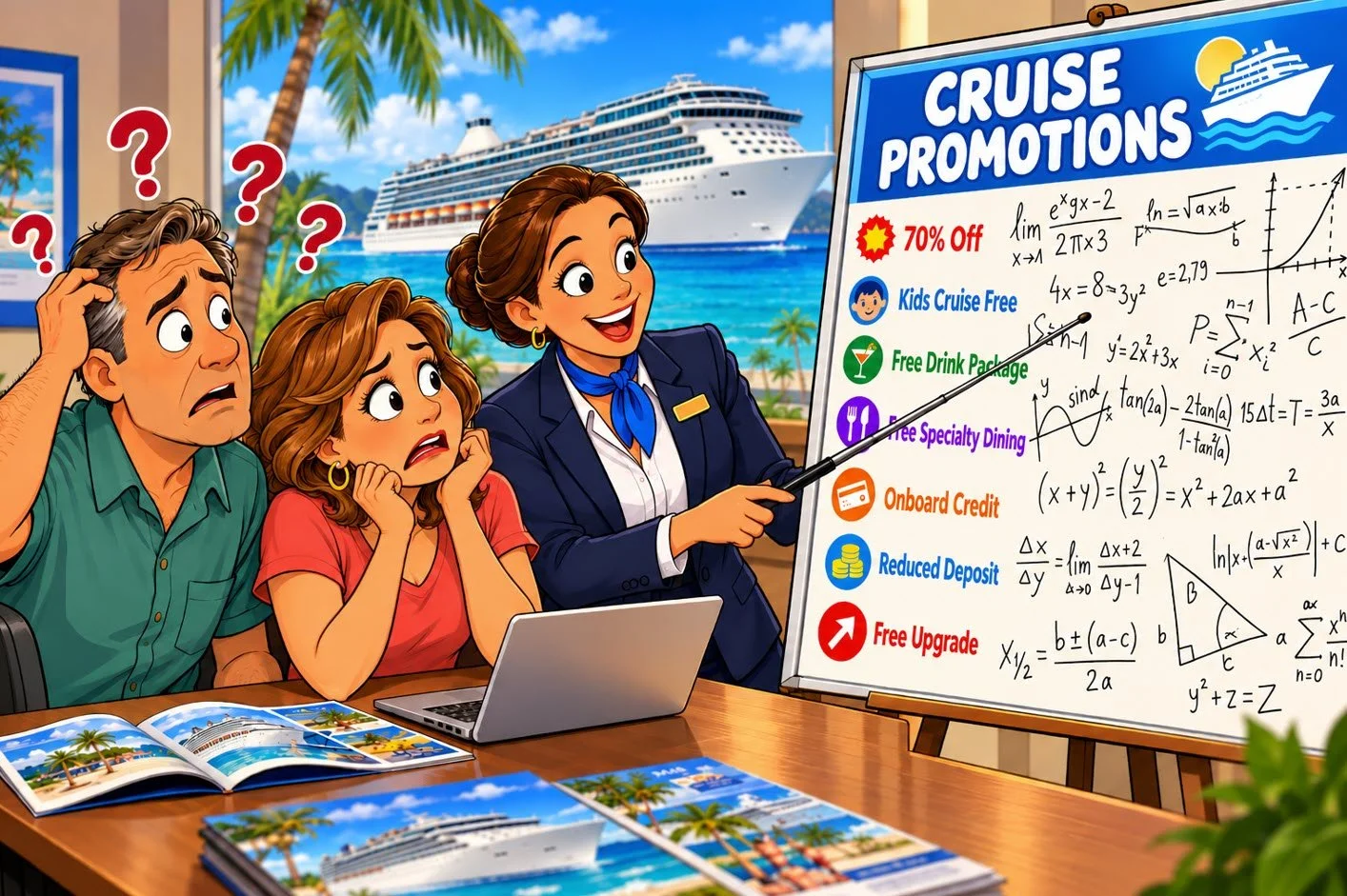
Cruise deals can feel like a maze, especially when every cruise line seems to advertise a “limited‑time offer,” “exclusive discount,” or claim to have the “best cruise package” that promises huge savings. Some travelers even assume the cruise lines are being tricky with their numbers, but much of the confusion usually comes from the sheer complexity of cruise promotions and the fact that most people don’t enjoy digging through fine print. When you understand how these promotions work, you can evaluate cruise pricing with confidence and spot the cruise discounts that genuinely save you money.
This guide breaks down the most common promotional tactics used across major cruise lines like Carnival, Royal Caribbean, Princess, MSC, and Norwegian. Each section explains what the tactic means, whether it’s truly a good deal, and how to handle it so you can make smart decisions. By the end, you’ll know how to interpret cruise packages and cruise promotions without feeling overwhelmed, and you’ll see how a cruise specialist like Epix Cruise and Travel can help you sort through the details with clarity.
Promotion or Tactic: Percentage‑Off Discounts
What It Means
Percentage‑off promotions are among the most recognizable cruise deals. You’ll see offers like “30% off all guests,” “40% off the second guest,” or “up to 50% off select sailings.” These discounts sound straightforward, but they often apply to the cruise fare only - not taxes, fees, port charges, or add‑ons. In simple terms, the cruise line is discounting the base fare, which is only one part of the total price.
Is It Really a Good Deal?
Percentage‑off promotions can be valuable, but the savings depend on the original fare. For example, if a cruise fare is $1,000 per person and the cruise line offers 30% off, the new fare becomes $700. However, once you add $150 in taxes and $200 in port fees, the total becomes $1,050. The discount is real, but it may not feel as dramatic as the headline suggests. Some travelers assume the cruise line is hiding something, but the reality is simply that the discount applies to one part of the fare structure.
How to Handle This Kind of Tactic
Always calculate the total cost, not just the discounted fare. Look at the final price after taxes, fees, and add‑ons. If you want to compare deals, use a simple spreadsheet or calculator to compare the total per‑person cost across multiple sailings. A cruise specialist can also help you quickly identify which percentage‑off promotions actually deliver meaningful savings.
Promotion or Tactic: “Kids Sail Free” or “Third/Fourth Guest Free”
What It Means
This promotion offers free cruise fares for additional guests in the same cabin, usually children. The cruise lines describe it as a family‑friendly deal that reduces the cost of traveling with kids. However, “free” typically applies only to the base fare, not taxes, fees, or required gratuities.
Is It Really a Good Deal?
It can be an excellent deal for families, but only if the cabin you choose allows three or four guests. For example, if the base fare for a child is $600 and the promotion removes that cost, you still pay taxes and fees, perhaps $150 to $200. That’s still a significant savings, but it’s not a completely free addition. The value depends on cabin availability and how many people you’re traveling with.
How to Handle This Kind of Tactic
Check cabin categories carefully. Not all cabins support extra guests, and the ones that do may sell out quickly during these promotions. If you’re traveling with kids, book early and confirm the total cost for each guest. A cruise specialist can help you find cabins that qualify and ensure you’re actually getting the discount.
Promotion or Tactic: Onboard Credit (OBC)
What It Means
Onboard credit is a promotional perk that gives you spending money to use on the ship. Cruise lines may offer $50, $100, or even $300 in OBC depending on the cabin category or length of sailing. You can use OBC for drinks, specialty dining, excursions, spa treatments, or onboard shopping.
Is It Really a Good Deal?
Onboard credit is valuable if you plan to spend money on the ship anyway. For example, if you receive $200 in OBC and you know you’ll buy a $150 excursion and a $50 specialty dinner, the credit offsets those costs. However, if you rarely spend money onboard, the value may be limited. The deal isn’t deceptive - it just depends on your spending habits.
How to Handle This Kind of Tactic
Estimate your onboard spending before evaluating the promotion. If you typically spend $300 on extras, then $200 in OBC is a strong benefit. If you prefer an all‑inclusive experience and don’t buy extras, focus on other types of cruise promotions instead. A travel advisor can help you compare OBC offers across sailings to find the best match for your travel style. When considering the value of an OBC promotion, also keep in mind that they are usually “per stateroom” (not per person) and they are usually a “use it or lose it” offer.
Promotion or Tactic: “Free Drinks,” “Free Wi‑Fi,” or “Free Dining Packages”
What It Means
These promotions bundle amenities into the cruise fare. Cruise lines may advertise free beverage packages, free Wi‑Fi, or free specialty dining. In reality, the cost of these amenities is sometimes built into the fare, but the promotion simplifies the decision for travelers who want an all‑inclusive feel.
Is It Really a Good Deal?
It depends on how much you value the included amenities. For example, a beverage package might cost $60 per person per day. On a seven‑day cruise, that’s $420. If the cruise fare is $300 higher during a “free drinks” promotion, you’re still saving money. However, if you don’t drink alcohol or plan to disconnect from Wi‑Fi, the added cost may not be worth it.
How to Handle This Kind of Tactic
Compare the fare with and without the bundled amenities. If the difference is less than what you’d pay for the amenities separately, it’s a good deal. If not, choose the lower fare and skip the bundle. A cruise specialist can help you calculate the true value of bundled promotions so you don’t overpay.
Promotion or Tactic: “Buy One, Get One” (BOGO) Offers
What It Means
BOGO promotions advertise a discount for the second guest in a cabin. You may see offers like “Second guest sails 50% off” or “Second guest free.” These promotions apply only to the cruise fare, not taxes or fees.
Is It Really a Good Deal?
BOGO deals can be strong, but the savings depend on the original fare. For example, if the first guest pays $1,200 and the second guest is 50% off, the second pays $600. Taxes and fees still apply to both guests, so the total might be $1,200 + $600 + $300 in taxes. The discount is real, but the final price may still be higher than expected.
How to Handle This Kind of Tactic
Always calculate the total cost for both guests. Compare BOGO promotions across multiple sailings to see which one offers the best overall value. A cruise specialist can help you identify which BOGO deals are truly competitive.
Promotion or Tactic: “Reduced Deposits”
What It Means
Reduced deposit promotions lower the upfront cost required to book a cruise. Instead of paying $250 per person, you might pay $50 or even $25. Cruise lines use this tactic to encourage early bookings and make cruise packages more accessible.
Is It Really a Good Deal?
Reduced deposits don’t lower the total cost of the cruise, but they do make it easier to secure a spot on the cruise without a large upfront payment. This can be helpful if you’re booking far in advance or planning a group cruise. The deal isn’t misleading - it simply spreads out your payments.
How to Handle This Kind of Tactic
If available, use a reduced deposit to secure a spot on a particular cruise, but note that you might not get to pick a specific stateroom until your full deposit is paid. Likewise, a fully paid deposit is sometimes needed to lock in your cruise fare. For these reasons, many good cruise specialists strongly recommend that their clients ignore reduced deposit promotions, and pay their full deposit upfront.
Promotion or Tactic: “Free Upgrades”
What It Means
Free upgrade promotions offer a higher cabin category for the price of a lower one. For example, you might pay for an interior cabin but receive an oceanview cabin. Cruise lines use this tactic to fill higher‑category cabins without lowering their advertised prices.
Is It Really a Good Deal?
Free upgrades can be excellent if you value the improved cabin. For example, upgrading from an interior cabin at $800 to an oceanview cabin normally priced at $1,000 saves you $200. However, availability is limited, and upgrades may apply only to certain sailings or cabin types. Sometimes upgrades are offered as a promotion at the time of booking. Other times, upgrades are offered after booking, but before your cruise.
How to Handle This Kind of Tactic
Confirm the exact cabin you’ll receive before booking, or before accepting the upgrade. If the upgrade is guaranteed, it’s a strong deal. If it’s “upgrade eligible,” ask for clarification. A cruise specialist can help you secure upgrades and verify cabin assignments.
Promotion or Tactic: “Early Saver” or “Advance Purchase” Discounts
What It Means
These promotions reward travelers who book early. Cruise lines may offer lower fares for bookings made six to twelve months in advance. The discount applies to the base fare and is designed to encourage early planning.
Is It Really a Good Deal?
Early saver discounts can be among the best cruise deals because fares often increase as the sailing date approaches. For example, a fare that starts at $900 may rise to $1,200 closer to departure. Booking early locks in the lower price, but cancellation policies may be stricter.
How to Handle This Kind of Tactic
If your travel dates are firm, early saver promotions are worth considering. Check the cancellation terms carefully and consider travel insurance. A cruise specialist can help you identify the best time to book.
Final Thoughts: How Epix Cruise and Travel Helps You Navigate Cruise Promotions
Cruise promotions are designed to attract attention, but they can also create confusion for travelers who aren’t familiar with cruise pricing structures. Most of the complexity comes from layered offers, bundled amenities, and the difference between base fares and total costs. When you understand how each tactic works, you can evaluate cruise deals confidently and choose the best cruise packages for your budget and travel style.
Epix Cruise and Travel specializes in helping travelers sort through these promotions with clarity. Instead of spending hours comparing fares, reading fine print, and calculating totals, you can rely on expert guidance that simplifies the process. Whether you’re looking for the best cruise discounts, evaluating bundled offers, or trying to understand the real value behind a promotion, Epix Cruise and Travel ensures you get the deal you want without the confusion and stress.