Executive Insight Report: The Rise of Cruise Ships as Corporate Event Venues
Executive Summary
The corporate events industry is entering a new phase of venue evaluation. While hotels and conference centers remain the dominant choices for meetings and incentive programs, an increasing number of organizations are reassessing where and how they bring employees, customers, and partners together.
Among the emerging options, cruise ships are gaining traction as strategic event venues rather than simply leisure destinations. For executive teams seeking differentiated experiences, predictable budgeting, and higher attendee engagement, the cruise model presents a compelling alternative to traditional land-based events.
This report examines the factors driving the shift and the implications for enterprise event strategy over the next three years.
The Corporate Event Market Is Becoming More Experience-Driven
The corporate event sector has returned to growth, but attendee expectations have changed significantly. Executive teams increasingly expect events to deliver measurable business outcomes while also providing memorable experiences that strengthen relationships, organizational culture, and performance.
Three trends are reshaping venue selection:
Greater emphasis on employee engagement and retention
Increased demand for experiential and destination-based events
Higher scrutiny of event budgets and cost transparency
These trends are creating opportunities for venue formats that can combine meetings, accommodations, dining, entertainment, and networking into a single environment.
Cruise ships are uniquely positioned to address these requirements.
Why Cruise Ships Are Gaining Momentum
Historically, cruise-based events were largely limited to incentive trips and executive retreats. Today, organizations are increasingly considering ships for:
Annual sales meetings
Leadership summits
Customer appreciation events
Partner conferences
Recognition programs
Product launches
The appeal stems from the ability to consolidate nearly every event component into one integrated platform with several key advantages.

The Experience Economy Favors Cruise-Based Events
Corporate events increasingly compete for attention in an environment dominated by remote work and digital communication.
Traditional meeting formats often struggle to create sustained engagement. Cruise environments, by contrast, naturally encourage interaction because attendees remain together for the duration of the event.
Executives report several benefits:
Increased participation in networking activities
Higher attendance at optional sessions
Stronger peer-to-peer relationships
Greater sense of exclusivity and reward
The result is an environment where business objectives and relationship-building occur simultaneously.
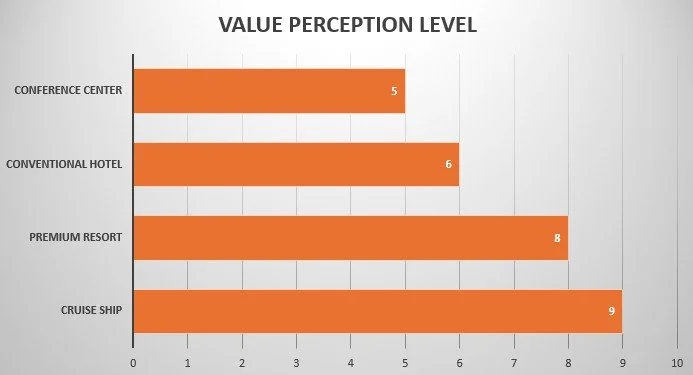
Estimated Executive Perception of Venue Value
The following illustration reflects emerging preferences among company event planners and executive sponsors.
(Scale: 1–10)
Economics Are Becoming More Favorable
Rising event costs have forced organizations to evaluate the total expense of meetings more carefully.
Land-based events often require separate negotiations for:
Hotel rooms
Meeting space
Food and beverage
Transportation
Entertainment
Team-building activities
Cruise programs can package many of these components into a single contract structure.
Strategic Use Cases
Cruise-based events are not appropriate for every corporate gathering. Highly technical conferences with thousands of participants may still favor major convention facilities.
However, cruise ships are particularly well suited for:
Sales Kickoffs: An immersive environment can strengthen team cohesion and energize performance initiatives.
Executive Retreats: The contained setting promotes strategic discussion without geographic distractions.
Incentive Programs: The perceived value of a cruise experience often exceeds its actual cost, creating a powerful recognition mechanism.
Customer and Partner Events: Shared experiences can accelerate relationship development and increase loyalty.
Forecast: The Next Three Years
Our analysis suggests that cruise ships will continue moving from a niche consideration to a mainstream option within the corporate events market. Projections for 2026 to 2028 show show cruises steadily gaining in corporate event popularity over the three year period. Several factors are likely to sustain this momentum:
Continued demand for experiential events
Pressure to maximize engagement per event dollar
Greater acceptance of nontraditional meeting environments
Improved onboard technology and meeting infrastructure
Executive desire to differentiate company culture and employer brand
Competition with other companies for high-caliber employees
Recommendations for C-Level Leaders
Organizations evaluating future event strategies should consider cruise-based programs when:
Relationship building is as important as collaboration & information delivery
Employee recognition and engagement are strategic priorities
Budget predictability is important
Leadership wants to create memorable experiences that reinforce culture
The most successful organizations will increasingly view venue selection not as a logistical exercise but as a strategic decision that directly influences business outcomes.
Addressing Common Concerns
Cruises are still uncharted territory for a lot of people, especially when considering one for their company, so there can be some concerns. Many concerns about hosting a corporate event at sea are rooted in unfamiliarity with the group cruise experience. Once executives receive accurate information and understand how modern cruise programs operate, these concerns often disappear.
Booking Complexity: Many executives assume organizing a group cruise is complicated. In reality, companies frequently work with a corporate cruise specialist who manages cruise selection & booking, meeting space, and event logistics, making the planning process surprisingly straightforward.
Health and Illness: Concerns about getting sick onboard are common, but modern cruise ships maintain rigorous sanitation protocols and have onboard medical facilities staffed by licensed healthcare professionals. Onboard illnesses reported in the media represent far less than 1% of all passengers cruising annually. People or more likely to contract a virus from schools, hospitals, and offices.
Alcohol Consumption: Some organizations worry that a cruise environment encourages excessive drinking. However, companies can establish customized beverage policies and design event programs that emphasize business objectives, networking, and team building. The risk is no bigger than land-based events.
Staying Connected: A common misconception is that attendees will be disconnected from the office or family back home. Today's cruise ships offer robust wi-fi and internet packages that allow guests to remain connected throughout the voyage.
Passport Requirements: Executives are often surprised to learn that many closed-loop cruises—those departing from and returning to the same U.S. port, allow alternative forms of documentation, reducing travel barriers for attendees.
Meeting Facilities: Some decision-makers question whether a ship can accommodate a professional event. In reality, modern cruise ships feature sophisticated business meeting venues for that exact purpose, plus presentation technology and event support services that rival many traditional conference facilities on land.
Bottom Line
Hotels and conference centers will remain essential components of the meetings ecosystem. However, the market is clearly evolving toward experiences that deliver both business value and emotional impact.
Cruise ships occupy a distinctive position at the intersection of hospitality, entertainment, and collaboration. For forward-thinking executives seeking to elevate engagement, simplify event delivery, and create memorable experiences, the question is no longer whether meetings can happen at sea.
The question is whether organizations can afford to overlook a venue model that is increasingly aligned with the future of corporate events.
Sources:
https://business.booking.com/en-us/business-travel-resources/articles/corporate-event-statistics/
https://brightspotincentivesevents.com/events/meetings-incentive-travel-trends/
https://www.cadencetravel.com/travel-blog/why-wellness-is-reshaping-meetings-and-incentives
https://midwestmeetings.com/2026/02/13/2026-incentive-travel-trends-report/